

Purchased first aid kits are generally laughable. If you could take care of the problem with what little the kit provides, you likely wouldn’t really need to care of it at all.
As an ER doctor, it is difficult for me to think about first aid kits. After 23 years of seeing every possible way to purposely, stupidly, or unknowingly hurt oneself and others, my list of what might be needed in a first aid “kit” is rather large. In an attempt to avoid bringing an ambulance as our sag wagon I’ve tried to narrow it down. On the plus side, we’ve eliminated some of the major, contributing behaviors that bring so many to my ER. We don’t drink alcohol, we don’t do drugs — except “inhaling” pot when riding around Pueblo — and we are no longer teenagers. On the downside, we’ve also added some dangerous behaviors like riding alone into grizzly country and being old on a bicycle.
To shorten the list I next tried to focus on age appropriate related issues. Unfortunately, that meant cancer and heart disease. Since we don’t smoke, colon and rectal cancer is our most likely cancer killer. A colonoscope just isn’t practical for a bike trip and I personally think that a bike seat is sufficient colorectal torture. For heart disease a scalpel is light and small and I do know how to start open heart surgery, but actually finishing it is still a bit messy and generally fatal. Of course, strokes and dementia are up there on the “kill” list, but if either of those happen on the trip I’m actually looking forward to finding a hungry grizzly bear.
Injuries while being on bikes in the woods was my next first aid equipment focus. Head injuries we hope to avoid with helmets but again the hungry grizzly is a backup plan if the helmet fails and the head injury is severe. Broken bones and bikes go hand in hand, but even if we had space for all the potentially necessary splints, it’s hard to ride a bike with a hare traction splint. 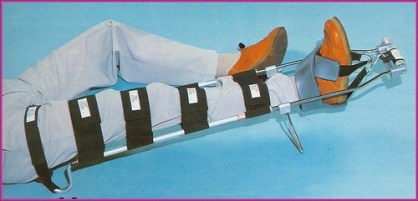 Maybe you could continue to ride with a figure eight for a broken collar bone or a SAM splint on one busted wrist. However, you would likely faint from the pain and fall off on your head.
Remembering that I have to help carry some of the gear, I finally narrowed it down to just two items with multiple applications. Regardless of what is broken, torn, or just plain bunged up, it will hurt. So item number one in the kit is a bottle of narcotics. Yes, I know about the opiate epidemic and I’m not furthering it. But when you are lying on the side of a dirt trail, 40 miles from a town with the most qualified medical personal being a first responder, and your arm “bends” in a new place, the only thing your really want is pain relief and transportation to a place that might fix you. That means likely a long wait and lots of pain while you wait, which brings us to the second item in my first aid kit.
Wanting to further minimize by having equipment serve multiple purposes, I made Gloria’s e-bike the second item in the first aid kit. Not only does it make it reasonable for her to accompany me on the GDMBR, it will be our emergency vehicle. With only a 70 lb weight limit in the BOB the injured part could be transported but not the person. The injured person will have to wait, like bear bait in a ditch, but at least comfortably chewing on narcotics. Meanwhile, the uninjured person – likely the more cautious one in our team of two – will up her pedal assist to maximum and race to the nearest town in hopes of requisitioning a pickup truck to be used as an ambulance.
It isn’t a perfect plan, but riding the GDMBR is likely a bit like a battle: no plan survives first contact. While my planning might be less than ideal, at least my years of ER experience will help me identify the problem and realize what I should have brought.
 Grumpy Grandpa's Great Bicycling Adventures